
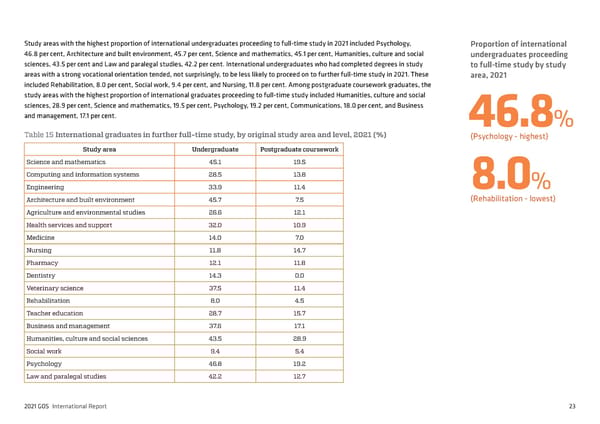
Study areas with the highest proportion of international undergraduates proceeding to full-time study in 2021 included Psychology, Proportion of international 46.8 per cent, Architecture and built environment, 45.7 per cent, Science and mathematics, 45.1 per cent, Humanities, culture and social undergraduates proceeding sciences, 43.5 per cent and Law and paralegal studies, 42.2 per cent. International undergraduates who had completed degrees in study to full-time study by study areas with a strong vocational orientation tended, not surprisingly, to be less likely to proceed on to further full-time study in 2021. These area, 2021 included Rehabilitation, 8.0 per cent, Social work, 9.4 per cent, and Nursing, 11.8 per cent. Among postgraduate coursework graduates, the study areas with the highest proportion of international graduates proceeding to full-time study included Humanities, culture and social sciences, 28.9 per cent, Science and mathematics, 19.5 per cent, Psychology, 19.2 per cent, Communications, 18.0 per cent, and Business and management, 17.1 per cent. 46.8% Table 15 International graduates in further full-time study, by original study area and level, 2021 (%) (Psychology - highest) Study area Undergraduate Postgraduate coursework Science and mathematics 45.1 19.5 Computing and information systems 28.5 13.8 8.0% Engineering 33.9 11.4 Architecture and built environment 45.7 7.5 (Rehabilitation - lowest) Agriculture and environmental studies 26.6 12.1 Health services and support 32.0 10.9 Medicine 14.0 7.0 Nursing 11.8 14.7 Pharmacy 12.1 11.8 Dentistry 14.3 0.0 Veterinary science 37.5 11.4 Rehabilitation 8.0 4.5 Teacher education 28.7 15.7 Business and management 37.6 17.1 Humanities, culture and social sciences 43.5 28.9 Social work 9.4 5.4 Psychology 46.8 19.2 Law and paralegal studies 42.2 12.7 2021 GOS International Report 23
 2021 International Graduate Outcomes Survey - QILT Page 27 Page 29