
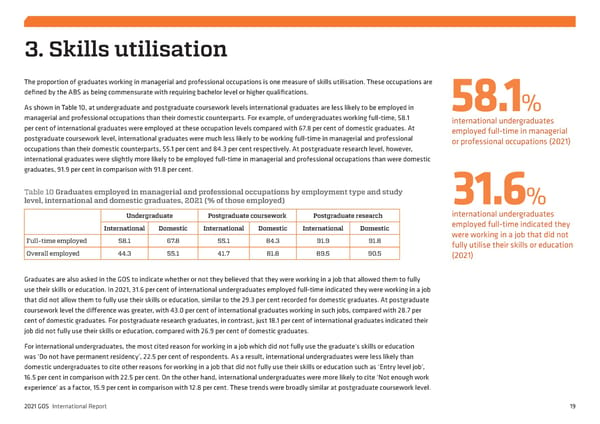
3. Skills utilisation The proportion of graduates working in managerial and professional occupations is one measure of skills utilisation. These occupations are defined by the ABS as being commensurate with requiring bachelor level or higher qualifications. As shown in Table 10, at undergraduate and postgraduate coursework levels international graduates are less likely to be employed in 58.1% managerial and professional occupations than their domestic counterparts. For example, of undergraduates working full-time, 58.1 international undergraduates per cent of international graduates were employed at these occupation levels compared with 67.8 per cent of domestic graduates. At employed full-time in managerial postgraduate coursework level, international graduates were much less likely to be working full-time in managerial and professional or professional occupations (2021) occupations than their domestic counterparts, 55.1 per cent and 84.3 per cent respectively. At postgraduate research level, however, international graduates were slightly more likely to be employed full-time in managerial and professional occupations than were domestic graduates, 91.9 per cent in comparison with 91.8 per cent. Table 10 Graduates employed in managerial and professional occupations by employment type and study level, international and domestic graduates, 2021 (% of those employed) 31.6% Undergraduate Postgraduate coursework Postgraduate research international undergraduates International Domestic International Domestic International Domestic employed full-time indicated they were working in a job that did not Full-time employed 58.1 67.8 55.1 84.3 91.9 91.8 fully utilise their skills or education Overall employed 44.3 55.1 41.7 81.8 89.5 90.5 (2021) Graduates are also asked in the GOS to indicate whether or not they believed that they were working in a job that allowed them to fully use their skills or education. In 2021, 31.6 per cent of international undergraduates employed full-time indicated they were working in a job that did not allow them to fully use their skills or education, similar to the 29.3 per cent recorded for domestic graduates. At postgraduate coursework level the difference was greater, with 43.0 per cent of international graduates working in such jobs, compared with 28.7 per cent of domestic graduates. For postgraduate research graduates, in contrast, just 18.1 per cent of international graduates indicated their job did not fully use their skills or education, compared with 26.9 per cent of domestic graduates. For international undergraduates, the most cited reason for working in a job which did not fully use the graduate’s skills or education was ‘Do not have permanent residency’, 22.5 per cent of respondents. As a result, international undergraduates were less likely than domestic undergraduates to cite other reasons for working in a job that did not fully use their skills or education such as ‘Entry level job’, 16.5 per cent in comparison with 22.5 per cent. On the other hand, international undergraduates were more likely to cite ‘Not enough work experience’ as a factor, 15.9 per cent in comparison with 12.8 per cent. These trends were broadly similar at postgraduate coursework level. 2021 GOS International Report 19
 2021 International Graduate Outcomes Survey - QILT Page 23 Page 25