
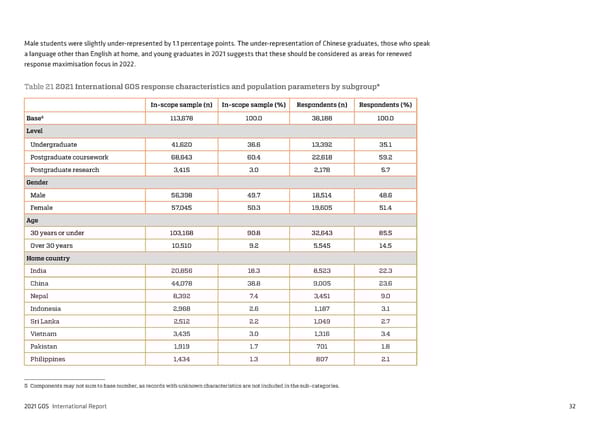
Male students were slightly under-represented by 1.1 percentage points. The under-representation of Chinese graduates, those who speak a language other than English at home, and young graduates in 2021 suggests that these should be considered as areas for renewed response maximisation focus in 2022. Table 21 2021 International GOS response characteristics and population parameters by subgroup* In-scope sample (n) In-scope sample (%) Respondents (n) Respondents (%) 5 Base 113,678 100.0 38,188 100.0 Level Undergraduate 41,620 36.6 13,392 35.1 Postgraduate coursework 68,643 60.4 22,618 59.2 Postgraduate research 3,415 3.0 2,178 5.7 Gender Male 56,398 49.7 18,514 48.6 Female 57,045 50.3 19,605 51.4 Age 30 years or under 103,168 90.8 32,643 85.5 Over 30 years 10,510 9.2 5,545 14.5 Home country India 20,856 18.3 8,523 22.3 China 44,078 38.8 9,005 23.6 Nepal 8,392 7.4 3,451 9.0 Indonesia 2,968 2.6 1,187 3.1 Sri Lanka 2,512 2.2 1,049 2.7 Vietnam 3,435 3.0 1,316 3.4 Pakistan 1,919 1.7 701 1.8 Philippines 1,434 1.3 807 2.1 5 Components may not sum to base number, as records with unknown characteristics are not included in the sub-categories. 2021 GOS International Report 32
 2021 International Graduate Outcomes Survey - QILT Page 36 Page 38